
Boom barriers · RFID tags · vehicle access control
Boom Barrier Installation in Kenya for Controlled Vehicle Access
We handle boom barrier installation in Kenya for estates, offices, hospitals, schools and car parks. Each barrier is sized for your traffic, fitted with safety loops and photocells, and linked to tags, remotes, intercoms or number-plate cameras so vehicles move quickly and every entry is recorded.
- Barrier, arm and motor sized for real traffic
- Safety loops and photocells on every lane
- Battery backup and manual release for outages

At most sites, the vehicle gate is the busiest and most argued-about point. Guards lift a pole by hand, drivers hoot, and the logbook fills with handwriting nobody can read. An automatic barrier changes that. Authorised cars pass in seconds, visitors stop for a quick check, and the system keeps a clean record of every movement.
This page covers how to choose a barrier, the entry methods available, the safety devices every lane needs and what a boom barrier installation in Kenya involves on the ground.
Gates and parking
Choosing a boom barrier: arm length, speed and duty cycle
Barriers look similar, but the motor inside decides how long the unit lasts. That is why every boom barrier installation starts with traffic numbers, not with a catalogue. Three questions shape the choice.
First, how wide is the lane? The arm must cover the full width with a little overlap. Most single lanes need a 3 m to 4.5 m arm. Wider gates need 5 m to 6 m arms, which call for a stronger motor and often a support post at the tip.
Second, how fast must it open? Busy car parks need fast barriers that open in 1 to 2 seconds. Estates and offices usually work well with 3 to 6 seconds, which is gentler on the mechanism.
Third, how many cycles a day? This is the duty cycle. A residential gate may see 200 openings a day, while a mall exit may see several thousand. Choosing a light-duty barrier for heavy traffic is the most common reason units fail early.
| Site | Typical arm | Opening speed | Duty |
|---|---|---|---|
| Small estate or office | 3 to 4 m | 3 to 6 s | Light to medium |
| Large estate or hospital | 4 to 5 m | 2 to 4 s | Medium to heavy |
| Mall or public car park | 3 to 4 m | 1 to 2 s | Heavy, continuous |
| Industrial yard | 5 to 6 m | 4 to 6 s | Medium |
We also look at the arm type. Straight arms suit open lanes, folding arms suit low roofs such as basement parking, and fence-style arms stop people ducking under.
Gates and parking
Entry control methods: RFID, remote, ticket and ANPR
The barrier is the muscle; the entry method is the brain. Most sites use more than one.
- RFID tags: a windscreen tag reads from a few metres away, so residents pass without stopping. This is the most popular option for estates.
- Cards at a reader post: staff present a card at the driver's window, which suits offices that already use card access.
- Remotes: handy for small sites, but remotes are easy to copy and hard to control, so we use them sparingly.
- Tickets: pay-and-display or ticket dispensers suit public and commercial car parks.
- Number-plate recognition (ANPR): cameras read plates and open for registered vehicles, with no tag needed.
For paid parking and plate reading, see our parking management and ANPR page. Visitor lanes often add a video intercom so the guard can talk to the driver.
Boom Barriers
Safety devices and loop detectors
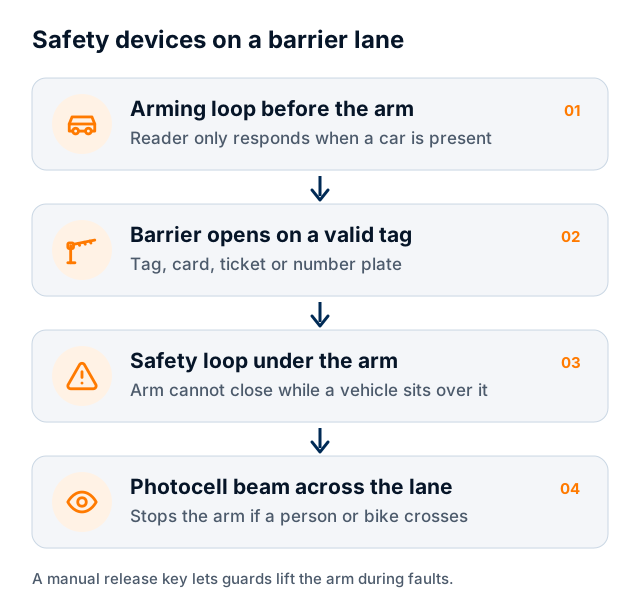
A barrier arm is heavy and fast, so safety is not optional. Every boom barrier installation in Kenya that we deliver includes these protections.
Loops matter more than most owners realise. Without them, the arm closes on a timer, and sooner or later it lands on a car roof.
How it works
Boom barrier installation steps and civil work
A clean job depends on good groundwork. Here is the usual sequence for a boom barrier installation in Kenya.
- Survey. We measure the lane, check traffic flow, find the power supply and look for underground services.
- Civil work. Our team casts a concrete plinth for the barrier and lays ducting for power and data under the driveway.
- Loops. Next, we saw-cut slots in the road, lay loop wire and seal it with a durable compound.
- Mounting. Then we bolt the cabinet to the plinth, fit the arm and adjust the balance spring.
- Wiring. After that, we connect power, readers, loops, photocells and the intercom or ANPR camera.
- Commissioning. Finally, we test every safety device, set speeds and train the guards on manual release.
Most single-lane jobs take two to three days, including curing time for concrete. Paved or tarmac surfaces need careful cutting and reinstatement, which we include in the quote.
Power backup
Power backup and outages
Power cuts are a daily reality on many sites, so every boom barrier installation needs a backup plan. Most modern barriers run on 24 V DC motors with built-in battery backup, which keeps them working for dozens of cycles during an outage. For busy gates, we add a UPS power backup for readers, cameras and the guardhouse equipment. We also agree whether the arm should stay down or lift when all power is gone, depending on your security policy.
Support and maintenance
Maintenance and spares after boom barrier installation
A barrier works hard, so a little care goes a long way. In fact, most breakdowns we see come from skipped servicing rather than poor equipment. We recommend a service every three to six months, depending on traffic.
We keep common spares such as arms, photocells and loop detectors, and we can maintain barriers we did not install.
Costs and pricing
Boom barrier installation cost factors
As a guide, a single-lane barrier with RFID tags, safety loop and photocells often falls between KSh 180,000 and KSh 350,000 installed. Heavy-duty and ANPR lanes cost more. The security systems price guide compares this with other systems, and a survey gives you a firm figure.
Coverage
Where barriers fit in your wider security
A barrier controls vehicles, but people still walk in.
Also think about the guards. A good boom barrier installation changes their job from lifting a pole to watching the gate. For this reason, we place the guardhouse controls, intercom and camera monitor so one person can see the lane, talk to drivers and override the arm without leaving the booth. Training covers manual release, adding tags and handling a driver whose tag fails. As a result, the gate keeps flowing even on a busy Monday morning. That is why we often pair barriers with pedestrian access control and CCTV installation at the gate. For estates, our page on apartment and estate security shows how these systems combine. Traffic rules on public roads remain the job of the National Transport and Safety Authority, so barriers we install stay inside private property lines.
To plan a boom barrier installation in Kenya for your gate, request a site survey. Tell us the lane width, daily traffic and how you want residents, staff and visitors to enter.
Get started
Book a site survey
Tell us about your site and an engineer will call you back within one working day to discuss your needs and arrange a visit.
- Clear, itemised written quote
- Security, network, fire and power from one team
- Support and maintenance after handover
Prefer to talk? Call +254 184 379 590
Frequently asked questions
How much does a boom barrier cost in Kenya?
A single-lane automatic barrier with RFID tags, a safety loop and photocells often costs between KSh 180,000 and KSh 350,000 installed. Heavy-duty units, long arms, ANPR cameras and extra civil work raise the price. We give a firm, itemised quote after measuring the lane and checking the power supply.
How long should the barrier arm be?
The arm should cover the full lane with a small overlap. Most single lanes need 3 to 4.5 metres. Wider gates need 5 to 6 metre arms with a stronger motor and a tip support. Basement entrances with low roofs need folding arms. We measure on site before choosing.
Can the barrier work during a power outage?
Yes. Most modern barriers have 24 V motors with battery backup that keeps them running for many cycles. We can add a UPS for readers and cameras too. If all power is lost, guards use a manual release key to lift the arm by hand.
Do boom barriers need regular maintenance?
Yes. We suggest a service every three to six months, depending on traffic. A visit checks spring balance, arm alignment, loops, photocells, gear wear and backup batteries. Regular care prevents most breakdowns and keeps the safety devices working as they should.
Planning a project or fixing a fault?
Tell us about the site. We will arrange a survey, give you a clear written quote and explain the options in plain language.