Mon to Fri, 8:00am to 5:00pmUtalii Court, Gesora Road, Nairobi

+254 184 379 590+254 719 450 317 Altinfo@gstechguard.co.ke

UPS sizing · batteries · power protection · IT support

UPS Installation in Nairobi for Resilient IT and Security Systems

GS TechGuard provides UPS power backup in Kenya for servers, networks, CCTV, access control, fire systems and offices. We measure your real load, size the UPS and batteries for the runtime you need, install them with proper earthing and surge protection, and keep them healthy with planned maintenance.

  • Sized from measured loads, not guesses
  • Online UPS for servers and sensitive equipment
  • Battery testing and replacement plans
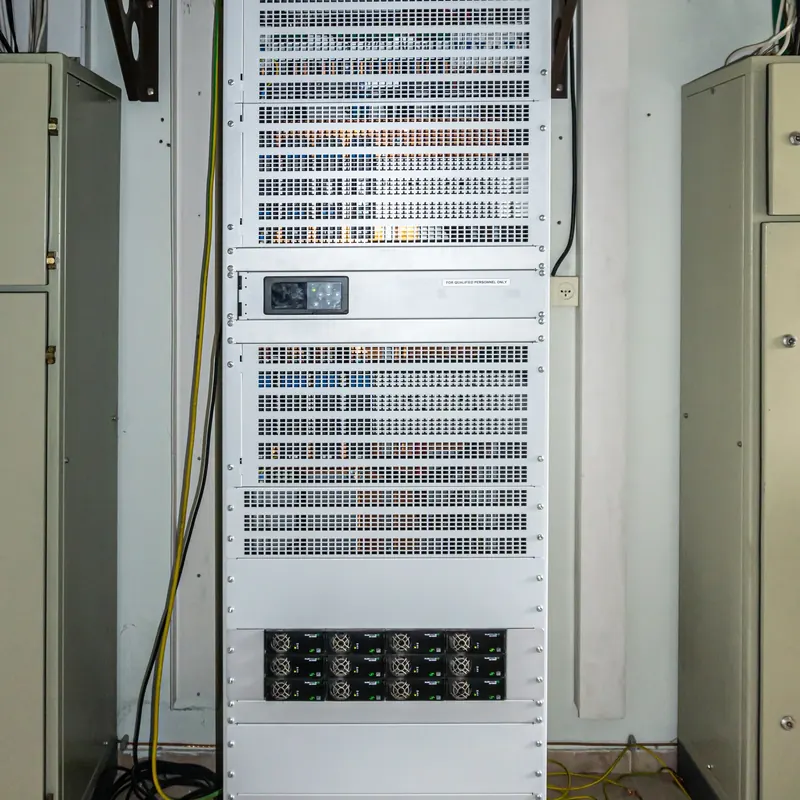
UPS power backup units in a server room rack in Kenya

In Kenya, power cuts, dips and surges are part of daily life. Each one can crash a server, corrupt a recording, lock a door in the wrong state or damage expensive equipment. A generator helps, but it takes time to start, and the switchover itself can upset sensitive devices. UPS power backup fills that gap. It keeps critical equipment running smoothly through short outages, bridges the gap until the generator starts and shuts systems down safely during long cuts.

This page explains why sizing matters, which UPS type suits which load, how we install and maintain systems and what affects the cost. It also links to our IT support, maintenance and relocation services, which share the same team.

Why choose us

Why UPS sizing matters

An undersized UPS shuts down when you need it most. An oversized one wastes money. Batteries that are too small give five minutes of runtime when you needed an hour. Therefore every UPS power backup project starts with three numbers.

We measure loads with a meter where possible, rather than adding up nameplate figures, which usually overstate real use. Then we choose a UPS that runs at about 50 to 70 percent of its rating, which leaves headroom and extends battery life.

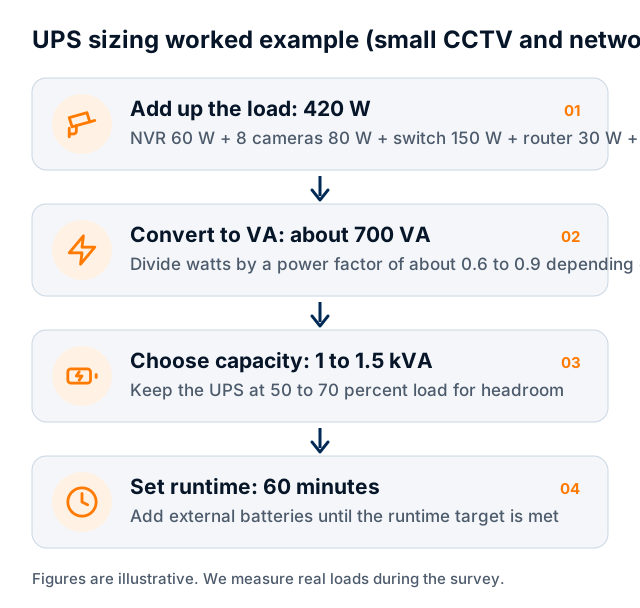
UPS sizing worked example for a small CCTV and network rack
A worked example: from watts to VA to runtime.

UPS Power Backup & IT Support

Worked example: from watts to VA to runtime

Here is a simple example for a small security and network rack.

Item Power
NVR recorder 60 W
8 IP cameras via PoE 80 W
PoE network switch 150 W
Router and firewall 30 W
Spare for growth 100 W
Total 420 W

Next, convert watts to VA (volt-amperes), which is how many UPS units are rated. Divide by the UPS power factor, often between 0.6 and 0.9. At 0.6, 420 W needs about 700 VA. To keep the UPS at a healthy load, we would choose a 1 to 1.5 kVA unit. Finally, we add external battery packs until the runtime target is met, for example one hour. For more detail, read our UPS sizing guide.

Fire safety

UPS for servers, CCTV, access control and fire alarms

Different systems need different backup strategies.

  • Servers and storage: an online UPS with enough runtime for the generator to start, plus software that shuts servers down safely if power does not return.
  • Network switches and Wi-Fi: backup for the core and edge switches so phones, cameras and access points stay connected.
  • CCTV: longer runtime is valuable, because thieves often strike during outages. See our CCTV installation page.
  • Access control: door controllers and locks need backup so doors behave predictably. Our access control page explains fail-safe and fail-secure locks.
  • Fire alarms: panels carry their own standby batteries, which we check, while related systems need their own UPS.
  • Offices: desktop computers, phones and printers may share a central UPS or use small units at each desk.
IT technician with a tablet in a server room

Power backup

Online, line-interactive and standby UPS

There are three main UPS designs, and the choice affects how well equipment is protected.

Type How it works Suits
Standby (offline) Passes mains straight through and switches to battery when power fails Single computers and home routers
Line-interactive Adds voltage regulation (AVR) to correct dips and surges without using the battery Small offices, network cabinets, CCTV
Online double-conversion Converts all power to DC and back, so equipment always runs from clean power Servers, server rooms, sensitive equipment, unstable mains

Where mains power is unstable, as on many Kenyan sites, an online UPS gives the best protection. It also handles generator power well, which can be rough. For larger sites, we install three-phase online UPS systems with external battery cabinets.

How it works

UPS installation, earthing and electrical readiness

A UPS is only as good as the installation around it. Our UPS installation in Nairobi and across Kenya covers:

  1. Survey. We check the distribution board, earthing, generator changeover and where loads sit.
  2. Design. Next, we choose UPS type, size and battery runtime, and plan input and output circuits.
  3. Electrical works. A qualified electrician installs dedicated input circuits and a maintenance bypass for larger units.
  4. Install. Then we position the UPS and batteries with ventilation and safe access.
  5. Connect loads. We connect equipment through rack power strips or dedicated output circuits.
  6. Configure. We set up network monitoring and shutdown software, plus email or SMS alerts.
  7. Test. Finally, we run a load and runtime test and record the results.

Good earthing protects people and equipment. We test the earth and recommend fixes where needed. Surge protection on incoming supplies is another cheap insurance against lightning season.

Maintenance and battery replacement

UPS batteries are consumables. Most sealed lead-acid batteries last about three to five years, less in hot rooms. Lithium-ion batteries last longer but cost more upfront. Without testing, a UPS can show "normal" for months while its batteries are no longer able to carry the load.

Our maintenance covers battery testing, firmware updates, fan and capacitor checks, cleaning and runtime tests. When batteries reach end of life, we replace them and dispose of the old ones responsibly. See our UPS repair and battery replacement page for details.

UPS power backup and generators

Most Kenyan businesses with a generator still need a UPS. The generator takes seconds to minutes to start, and the changeover causes a short break. The UPS carries the load through that gap with no interruption. In addition, an online UPS cleans up generator power, which often has voltage and frequency swings. We coordinate UPS settings with your generator and changeover switch so they work together.

UPS Power Backup & IT Support

Solar and inverter systems

Many sites now use solar inverters with batteries. These can work alongside a UPS, but they are not always a direct replacement for critical IT loads. Some inverters switch too slowly or produce power that sensitive equipment dislikes. We review your setup and advise where a dedicated UPS is still needed. For energy regulations, the Energy and Petroleum Regulatory Authority oversees licensed solar installers in Kenya.

Costs and pricing

UPS cost factors

As a rough guide, a 1 to 3 kVA online UPS for a small server or network rack, installed with an hour of runtime, often falls between KSh 60,000 and KSh 250,000, depending on brand and battery size. Larger systems are quoted after a survey. Our price guide has more context.

Why choose us

Why choose GS TechGuard for UPS power backup

  • Sizing from measured loads and agreed runtime targets.
  • Online UPS where power quality demands it.
  • Proper electrical works, earthing and surge protection.
  • Monitoring, alerts and safe shutdown configured.
  • Battery testing and replacement plans that prevent surprises.

To plan UPS power backup for your servers, security systems or office, request a site survey.

Get started

Book a site survey

Tell us about your site and an engineer will call you back within one working day to discuss your needs and arrange a visit.

  • Clear, itemised written quote
  • Security, network, fire and power from one team
  • Support and maintenance after handover

Prefer to talk? Call +254 184 379 590

We reply within one working day. Or call +254 184 379 590.

Frequently asked questions

What size UPS do I need?

Add up the real power your equipment uses in watts, convert to VA using the UPS power factor, then choose a UPS that will run at about 50 to 70 percent load. Add batteries until the runtime meets your target. For example, a 420 W rack usually needs a 1 to 1.5 kVA UPS. We measure loads during the survey to get it right.

How long do UPS batteries last?

Most sealed lead-acid UPS batteries last about three to five years, and less in hot rooms or where outages are frequent. Lithium-ion batteries last longer. Regular testing shows when capacity drops, so you can replace batteries before they fail during an outage.

Can a UPS run CCTV for hours?

Yes, with enough battery capacity. CCTV recorders, switches and cameras draw modest power, so external battery packs can extend runtime to several hours. We size the UPS and batteries to your runtime target and recommend efficient PoE switches to keep the load low.

Do I need a UPS if I have a generator?

In most cases, yes. A generator takes time to start, and the changeover causes a break that can crash servers and reboot cameras. A UPS carries the load seamlessly through that gap and cleans up generator power for sensitive equipment.

Areas we serve

Installed and supported across Kenya

Our Nairobi team travels to sites countrywide. Choose your town for local details.

Planning a project or fixing a fault?

Tell us about the site. We will arrange a survey, give you a clear written quote and explain the options in plain language.

CallWhatsAppAsk usQuote